

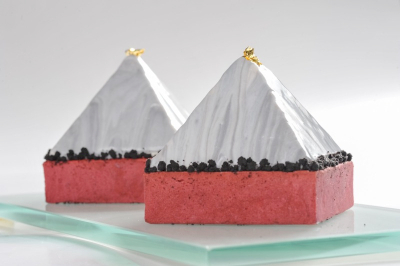
What happens when architectural techniques in geometric forms are combined with the delicious world of pastry and cake?
It all began with Ukrainian pastry chef Dinara Kasko and her experimental techniques, which transform edible creations into works of art. A former architect, she has created a variety of contemporary art pieces by combining 3D printing techniques with diverse shapes, one of which is geometric design.
Geometric shapes are a variety of forms composed of different line elements, such as straight, curved, zigzag, and spiral lines, as well as various shapes such as squares, rectangles, circles, kites, and other forms that serve as basic design elements.
Before being introduced to letters and numbers, one of the earliest stages of human learning is recognizing different shapes. For example, by recognizing triangles and circles, it becomes easier to read letters and numbers that contain these shapes, such as the letters “A,” “Z,” “V,” “O,” “C,” and “D,” as well as the numbers “7,” “4,” “0,” “8,” and others. Shapes that generally have well-defined contours in various directions are known as geometric shapes.
Not only does this concept combine geometric elements, but it also transforms these shapes through the latest pastry trends, adding a unique twist to every element. Special applications such as marquise cakes, pralines, mousse cakes, quiches, and marble cookies in bold colors are combined with a variety of signature products from PT Gandum Mas Kencana, creating a contemporary trend that can help take food creators’ businesses to the next level.

